This guest post is from Mark, an English chili enthusiast now living in snowy Southern Alberta, Canada. If you’d like to submit a guest grow log to this site, don’t be shy: get in touch. Over to you, Mark.
24th December 2011
I’m a transplanted Brit with a serious chili habit. With a long five-month winter dragging on, I decided to set up some grow lights. I didn’t want anything extravagant—just something practical and effective. Using guidance from this site, I bought two double fluorescent fixtures with wide-spectrum Grow-Lux bulbs and made a simple reflector from cardboard to help maximize light distribution.
I lined the inside of the reflector with silver Christmas wrapping paper (it was cheap) and bent back the small reflectors that came with the fixtures so the homemade reflector would sit snugly. I cut a 4′ x 2″ slot so it would rest on the light fixture properly.
Next I rigged up chains—about five feet for each end—and screwed hooks into the ceiling so I could position the lights roughly 3–4 inches above the seedlings.
14th January 2012
Seeds arrived from England. This year’s lineup:
- Butch T x 10
- Trinidad 7 Pot Jonah Red x 10
- Bhut Jolokia x 10
- Chocolate Habanero x 10
- Orange Habanero x 15
- Habanero Caribbean Red x 20
- Habanero White x 15
- Habanero Yellow Bumpy x 15
- Safi Scotch Bonnet x 15
- Aji Lemon x 15
- Aji Amarillo x 15
- Peter Pepper Yellow x 10
- Peter Pepper Orange x 10
- Peter Pepper Red x 10
- Numex Big Jim x 10
Yes, it’s probably overkill, but I couldn’t help myself.
Germination
I used the wet tissue germination method mentioned on this site. I placed ten seeds of each variety on a napkin and gave them a light soak of chamomile tea before sealing them up to germinate.
I also bought two heated 72-cell propagators and planted 144 seeds (yes, I admit it was ambitious). Four days later I had over 40 seedlings showing—much better than I expected.
I ran an 18-hour light / 6-hour dark cycle and, for reasons of mood, kept Motorhead and Slayer on repeat while they grew. Most of them developed well under that regimen.
25th January 2012
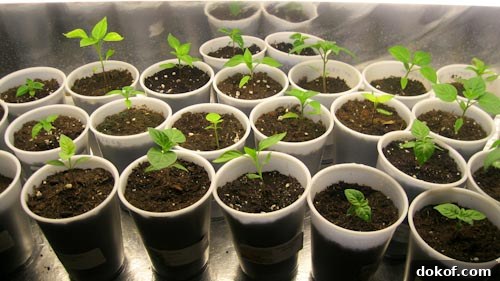
Unfortunately I lost most of the White and Chocolate habaneros; only one Bhut survived. I mourned the losses and then started potting the survivors into plastic beer cups with drainage holes drilled in the bottom. To cover the expanding tray area I bought a second light fixture and adjusted the reflectors the same way as before.
15th February 2012
Under the lights and still subjected to Motorhead and Slayer, the remaining plants are doing well. There are too many seedlings to fit into one photo. I plan to repot them again soon and add one more set of lights to keep up with their growth. I’m looking forward to some bright Albertan sun to give them an extra boost once the weather turns.