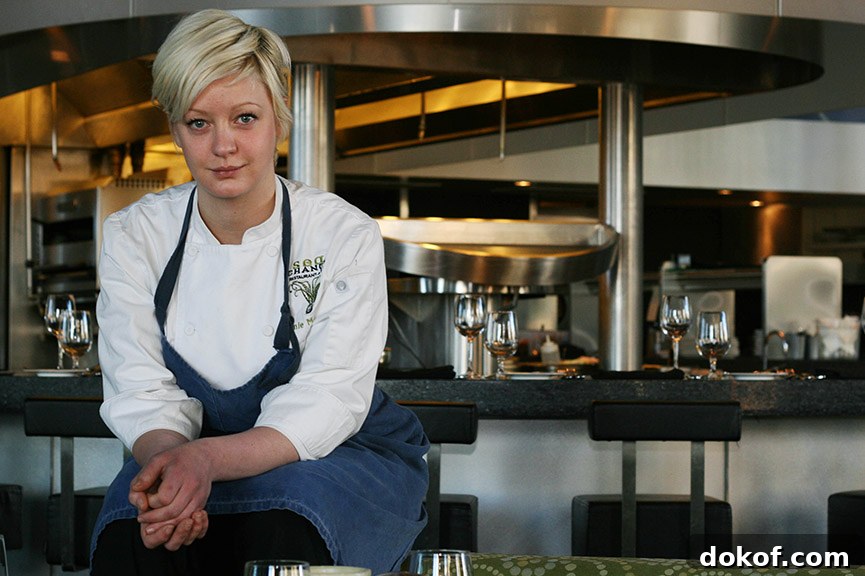
Devoted to Sustainable Seafood
Jamie Malone prepares outstanding seafood at Minneapolis’ acclaimed Sea Change, situated on the Mississippi River within the modern Guthrie Theater complex. Her thoughtfully curated menu highlights a range of sustainably sourced species, prepared simply and precisely — a style that earned her recognition on Food & Wine’s list of Best New Chefs. We spoke with Jamie about the realities of serving fresh seafood in landlocked Minnesota, her favorite fish, and how she manages a hectic pre-show rush.
AndrewZimmern.com: What are the biggest challenges of running a seafood restaurant in the Midwest?
Jamie Malone: Sourcing isn’t as limiting as people expect. Because we do a lot of volume and most of it is fish, I bring in roughly 100 to 200 pounds of seafood per day. That allows me to source nearly anything I want and receive it as fresh as if we were on the coast. The bigger challenge is distance from the fishermen themselves. I don’t get to speak directly with many of the people who harvest the product, and I miss the knowledge and stories that come from working alongside them. There’s so much to learn from the people who pull product from the water.
AZ.com: What’s on your top-five list for sustainable fish?
JM: Oysters. Spanish mackerel. Farmed Arctic char. Sardines. Rainbow trout.
AZ.com: You were just named one of Food & Wine’s Best New Chefs. What’s the best part of getting this kind of recognition? Any downsides?
JM: The best part is the doors it opens. I’ve had opportunities to meet and collaborate with people at the top of their fields, which is both exciting and inspiring. The downside is the pressure to adapt as demands pull me in different directions. I know I need to be in my kitchen as much as possible, which means learning to balance opportunities with staying true to the restaurant.
AZ.com: What are a few lessons you’ve learned from executive chef Tim McKee?
JM: Tim’s food is incredibly refined and he makes discipline look effortless. Observing his focus on detail and consistency has had a big influence on how I approach technique and execution.
AZ.com: What are the challenges of working in a restaurant attached to a theater? Is it difficult dealing with a big pre-show rush?
JM: It’s definitely a challenge. When ticket sales peak and 150 people are trying to dine before a single show, the pressure mounts quickly. My sous chef, Ryan Cook, and I have spent years refining systems to keep service moving without forcing the cooks to scramble. The priority is a calm, organized environment — even during chaotic moments. Cooks need to remain focused and composed in order to deliver consistently good food.
AZ.com: When cooking seafood, it often seems like it’s best to let the ingredients shine. Any tips for practicing restraint?
JM: Be pragmatic. Everything on the plate must earn its place and serve a purpose. Understand why you enjoy the flavors and textures you choose to highlight, then give each component the role that best expresses that pleasure. Restraint comes from clarity of intention.
AZ.com: Favorite restaurant in the Twin Cities?
JM: La Belle Vie.
AZ.com: What’s in your fridge?
JM: Oysters. Six-month-aged ribeye. Beef fat. Koji shio. Champagne. A few chanterelles from the bog. Dog treats. You picked a good day to ask!
Get Jamie’s recipe for Oysters with XO Gravy.
Before earning her culinary degree from Le Cordon Bleu, Chef Malone traveled extensively through Hong Kong, Vietnam and Europe, studying regional cuisines and food culture. She developed her passion for cooking in high school as an avid listener of NPR’s The Splendid Table, an influence that continues to inform her approach. She also admires Chef Thomas Keller for his organization and commitment to craft.
“Sea Change gives patrons well-researched options for sustainable fish that aren’t always on everyone else’s top-five lists,” Chef Malone said. “We work constantly to stay on top of the evolving world of sustainability.”
Chef Malone describes her approach to cooking as gestalt — she thinks not only about what’s on the plate, but who will eat it and how the whole dining experience will feel.
“I like working with my hands every day,” Chef Malone said. “My short-term goals and my long-term ambitions are essentially the same: when I finish my work each day, I want the dining room to be full of happy people.”
Jamie Malone was a 2013 semifinalist for the James Beard Foundation’s Rising Star Chef award and was named a Food & Wine Best New Chef in 2013.